
MYOPIA MANAGEMENT
HOYA MiYOSMART iQ
INTRODUCING HOYA MIYOSMART IQ
Clear vision today. Care for tomorrow.
A new level of myopia management for children. MiYOSMART iQ combines vision correction with an advanced lens design developed to help manage the progression of short-sightedness.
CLINICAL RESULTS
9 in 10
Children showed no clinically relevant myopia progression in the first 12 months of wear, according to HOYA’s reported results.
Minimal eye growth on average.
HOYA reports that, on average, MiYOSMART iQ wearers showed no clinically relevant myopia progression during the first 12 months of wear. The clinical definition used is a spherical equivalent refraction change of −0.50D or more over 12 months.
HOYA's first spectacle lens with reported clinical evidence for effective control of myopia progression from the age of 4 years, as a monotherapy.
Results vary. Outcomes can differ depending on a child’s age and their clinical measurements when treatment begins. No lens can guarantee that myopia will stop progressing, so regular monitoring remains important.
MADE FOR REAL CHILDHOOD
Comfortable vision for busy days
The updated lens design is intended to provide clear, comfortable vision and improve lens aesthetics, including a flatter curvature and reduced edge thickness compared with the previous MiYOSMART generation.
The S.P.A.R.K. protective coating is designed for the demands of everyday wear, helping lenses resist scratches, smudges, dust and water while providing 100% UV protection from the front of the lens.
Ask our team whether MiYOSMART iQ or a photochromic option is suitable for your child’s prescription, lifestyle and needs.
- Clear, comfortable vision for daily activities.
- Enhanced scratch resistance and easier cleaning.
- Smudge-, dust- and water-repellent performance.
- 100% UV protection from the front of the lens.
- A lens design created for growing, active children.
A COMPLETE APPROACH
Small daily habits make a difference, too
Myopia management works best as part of a broader approach to your child’s eye health. Alongside professional advice and regular checks, simple habits can support healthy visual routines.
Spend time outdoors
Encourage your child to spend at least two hours outdoors each day where practical.
Take regular screen breaks
Try the 20:20 habit: after 20 minutes of close work, take a break and look into the distance or go outside.
Keep reading at a sensible distance
Encourage your child to hold reading material at least 30 cm away from their eyes.
Keep up with eye checks
Regular appointments help your optometrist monitor changes and review whether the management plan is working for your child.
FREQUENTLY ASKED QUESTIONS
Who might MiYOSMART iQ be suitable for?
It is designed for children with myopia, with HOYA reporting clinical outcomes in children aged 4–12 years and use from age 4. Suitability depends on an individual assessment by an eye care professional.
Does it replace regular eye examinations?
No. Regular examinations and follow-up appointments are an important part of myopia management, so your optometrist can monitor your child’s prescription and eye health.
Will it stop my child’s myopia completely?
No treatment can guarantee that myopia will stop progressing. MiYOSMART iQ is designed to help manage progression; individual outcomes vary and need to be monitored over time.
Is it just an ordinary pair of glasses?
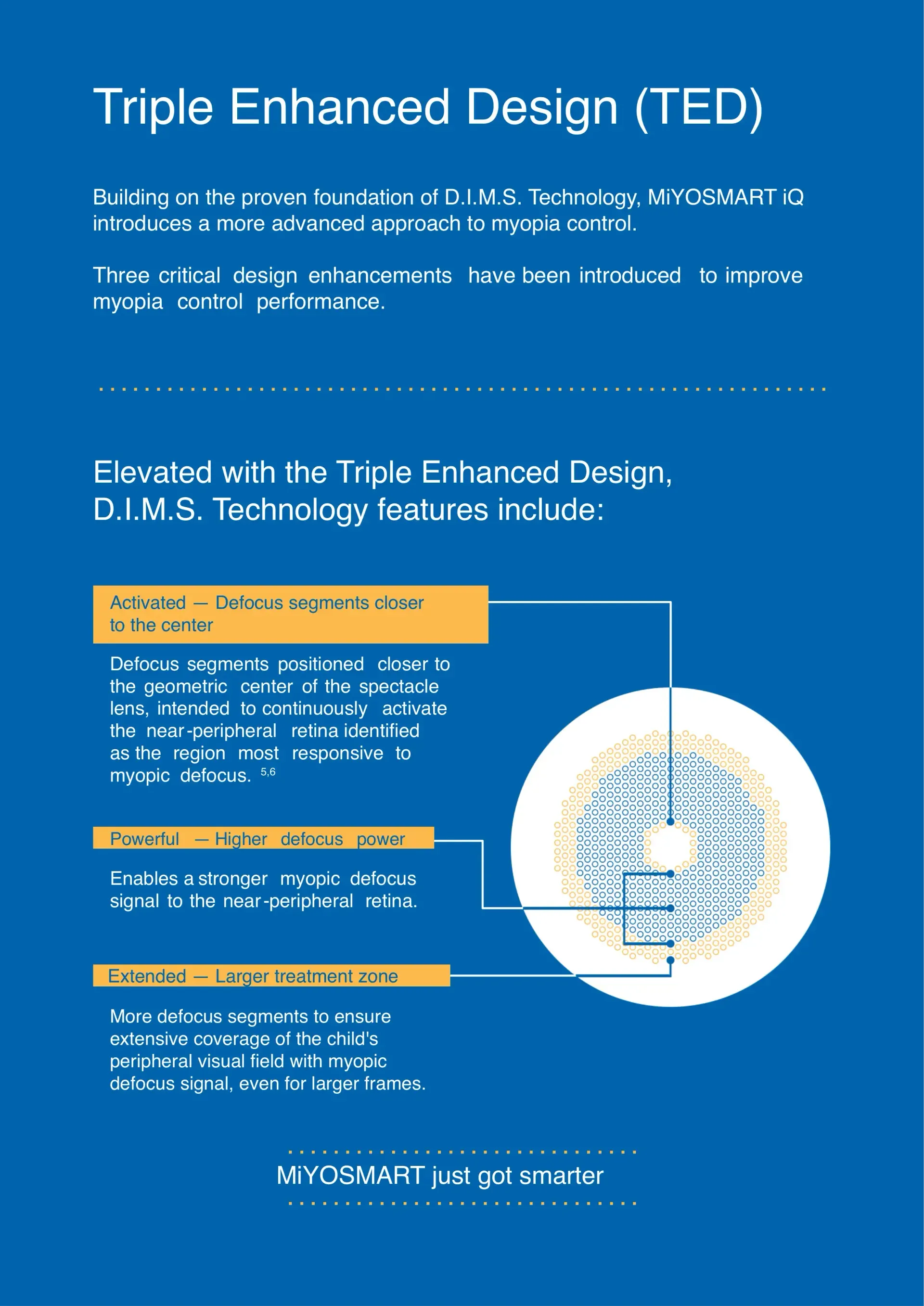
It corrects vision while using D.I.M.S. Technology and Triple Enhanced Design to deliver a treatment signal intended to help slow myopia progression. Your optometrist can explain how this differs from standard single-vision lenses.
Let's talk about your child's eyesight
If your child is short-sighted or their prescription seems to be changing, book an appointment to discuss myopia management and whether MiYOSMART iQ could be appropriate.
Clinical note
Myopia management at your independent opticians. Ask your optometrist about suitability, expected outcomes and follow-up.
Product information based on HOYA MiYOSMART iQ consumer materials, June 2026. The clinical outcomes described are not a guarantee for an individual child; results vary and regular professional monitoring is important.